University of Michigan · Machine-learning course research · Jan–Sept 2021
Changing one feature in a generated face
ICA-SeFa: Interpretable Semantic Directions in GANs
This project explored how to change a feature such as hair color without changing several others. I helped implement ICA-SeFa, a method for finding these edits in a trained GAN, and ran its human evaluation.
I designed and ran the human study, recruited annotators, analyzed the results, and helped implement the method and write the report.
- Human annotators
- 8
Participants in the course study.
- Directions rated per method
- 35
Manually selected from 200 discovered directions.
- Methods compared
- 2
ICA-SeFa and the SeFa baseline.
Starting point
Checking the same edit across faces
An editing direction changes the inputs used to generate an image. I designed the human study to check whether each direction changed a recognizable feature consistently across different faces.
How it came together
- 01
Find editing directions
I helped implement a method that applies FastICA to a pretrained generator's weights. It builds on SeFa and finds editing directions without training another neural network.
- 02
Compare the images
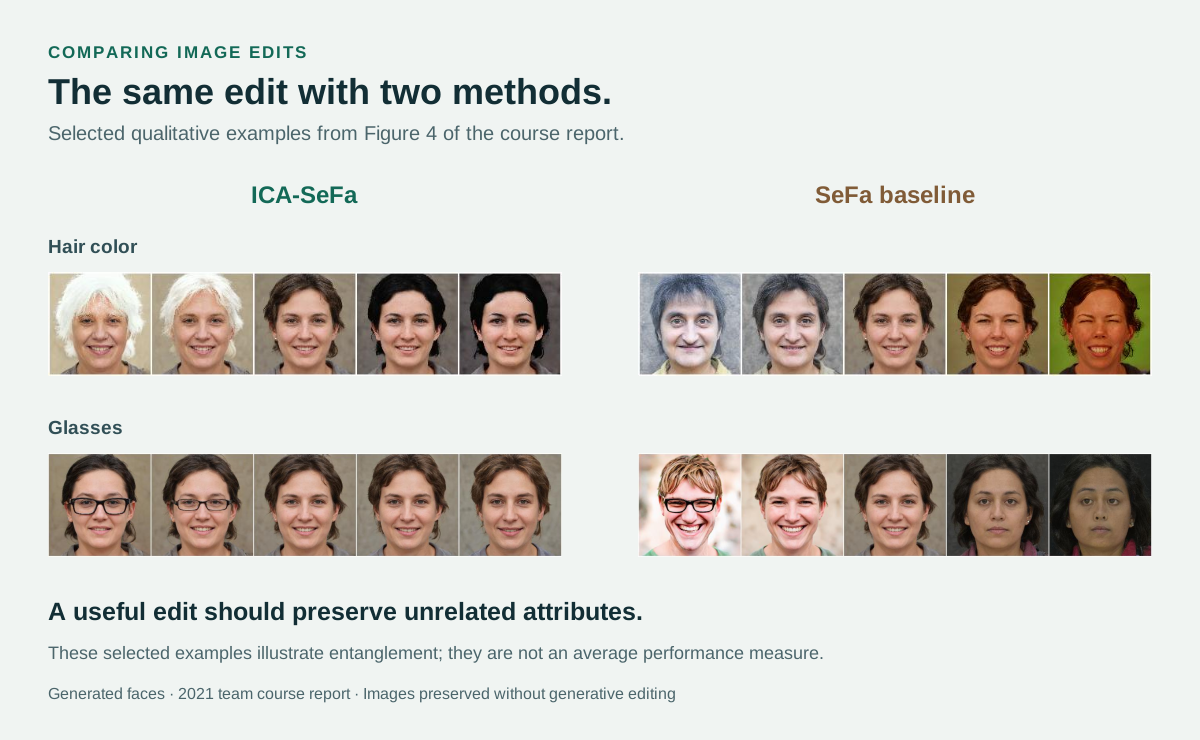
We generated sequences of edits with StyleGAN2 trained on FFHQ, then compared similar features and checked whether other parts of the face changed too.
- 03
Collect human ratings
I recruited eight annotators, designed and ran the rating study, and analyzed their scores for the selected directions. The team also used CLIP to compare edits with named attributes.
Explore an editing direction
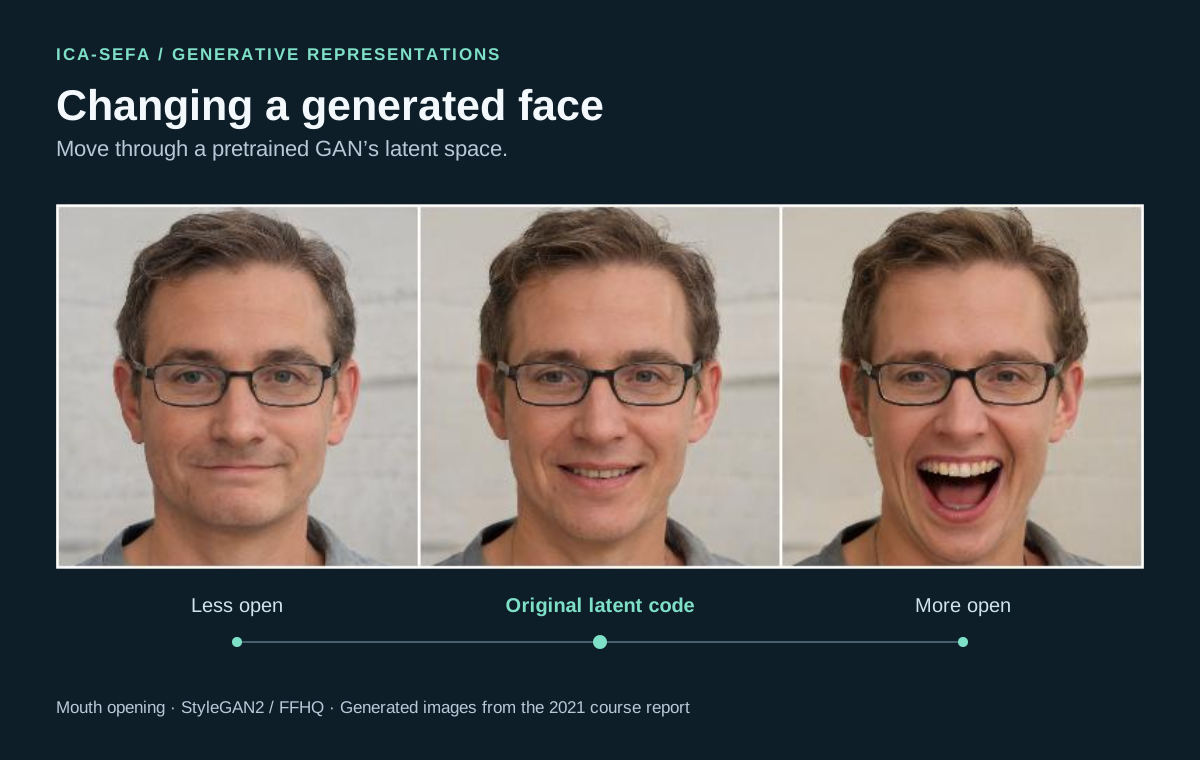
Compare the mouth edits
Select a position to view one of three original Figure 1 frames from the 2021 course report. This viewer displays the saved images without generating frames between them.
Original

Results for the selected directions
The selected ICA-SeFa examples showed clearer control over individual features, and its highest-rated directions received higher human scores than SeFa's. The study used a manually selected subset, so these results don't describe the average across all discovered directions.
The course experiment found 200 directions per method, manually selected 35 from each for human rating, and reported the ten highest-scoring directions. The mean opinion scores are averages of human ratings, rather than classification accuracy.
Dongyang Zhao implemented the CLIP analysis, which measured how the editing directions correlated with named attributes.