University of Michigan · Natural-language-processing course project · Sept–Dec 2021
Checking XLNet's answers against its explanations
XLNet for Verifiable Commonsense Reasoning
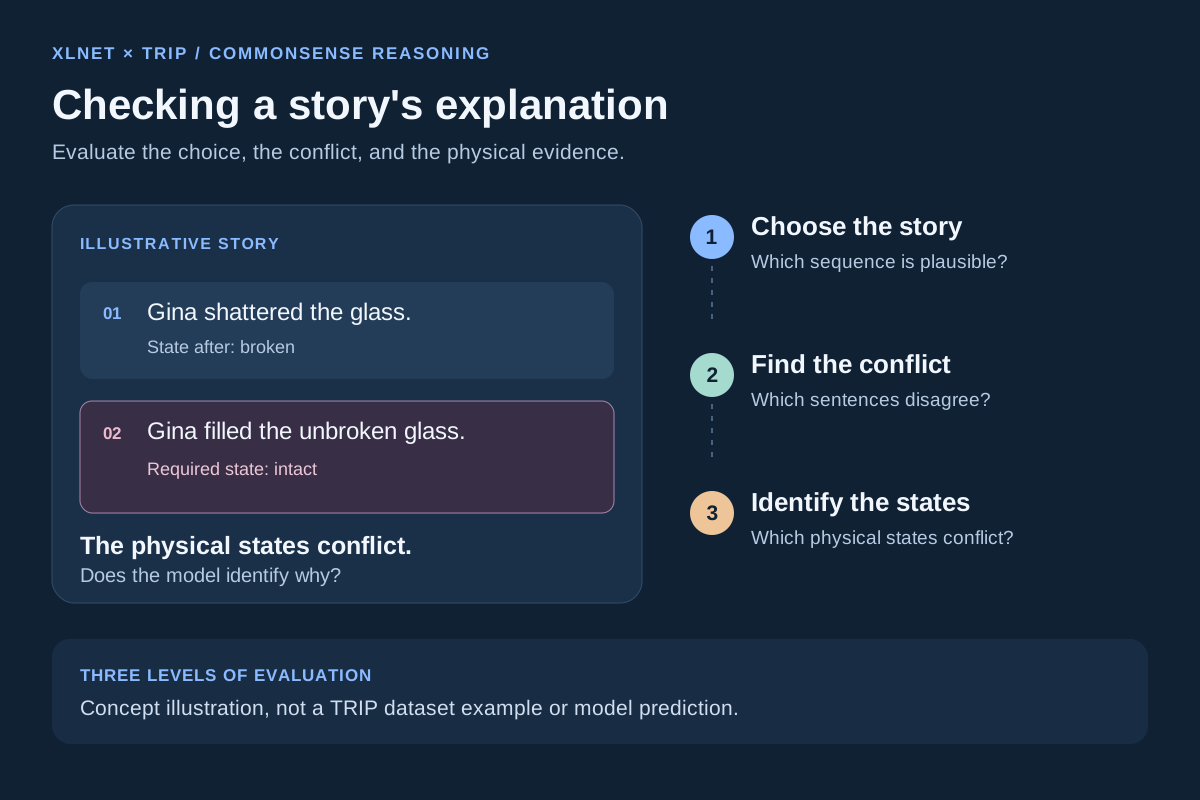
I adapted the TRIP reasoning pipeline to XLNet to test whether it could identify why a short story was physically impossible. The evaluation checked its story choice, the conflicting sentences, and the physical states behind the conflict.
I integrated XLNet-base, fine-tuned it, compared training losses, evaluated the results, and wrote the final report.
- Levels of reasoning
- 3
Accuracy, consistency, and verifiability.
- Supervision signals
- 4
Preconditions, effects, conflicts, and story choice.
- Story accuracy
- 80%
Validation result with state-classification losses omitted.
Starting point
What the model had to explain
TRIP pairs a plausible story with an implausible one. To explain the conflict, the model has to identify the relevant sentences and the physical states before and after an action.
How it came together
- 01
Adapt the model
I added Hugging Face XLNet-base-cased to the published TRIP pipeline, adapting the tokenizer, model configuration, and representations.
- 02
Compare training losses
During fine-tuning, I removed selected losses to examine how training on story choice, sentence conflicts, and physical states affected each result.
- 03
Evaluate the explanation
I compared story accuracy with consistency and verifiability. Those two measures also check the conflicting sentence pair and the physical states that explain it.
Removing the state losses
Without the state-classification losses, story accuracy rose from 76.7% to 80.0%, while consistency fell from 12.7% to zero. Verifiability was zero in both configurations: neither met the full requirements for explaining the conflict in this validation table.
Story choices and supporting explanations
XLNet validation results from Table 1 of the December 2021 course report. Higher is better; the measures have different requirements.
Accuracy
Consistency
Verifiability
Bars share a zero baseline · scale 0–100%
Accuracy counts correct story choices. Consistency also requires the correct conflicting sentence pair; verifiability adds the relevant physical-state predictions.
These results come from the original course report. The archived notebook records my XLNet adaptation, and the experiments haven't been rerun for this portfolio. The two configurations don't establish statistical significance.